






Research 01
センシング技術による製造データの収集・解析で、品質管理や製造ラインのスマート化を実現する
センシング×スマートファクトリー
Achieving smart quality control and manufacturing lines by collecting and analyzing manufacturing data with sensing technology
Sensing × Smart Factory
産業界と連携し、“センシング×スマートファクトリー” と題して,センシング技術の解析により培ってきたノウハウを元に、日々計測される製造データの解析や製造工程のスマート化に関する研究を行っています。製造データは分野・企業・工程間で大きく異なっており共通したノウハウが作りづらく、またデータを計測していても活用されにくいという課題があります。、そこで私たちは、新たにセンシング技術を利活用することで品質予測や投入計画・配置最適化などの製造のスマート化の実現に取り組んでいます。
In collaboration with industry, we are conducting research titled “Sensing × Smart Factory,” leveraging expertise cultivated through the analysis of sensing technologies to analyze daily manufacturing data and advance the smartization of manufacturing processes. Manufacturing data varies significantly across fields, companies, and processes. This makes it difficult to establish common know-how, and even when data is collected, it is often underutilized. To address this issue, we are working to realize smarter manufacturing by newly applying sensing technologies for quality prediction, input planning, and layout optimization.
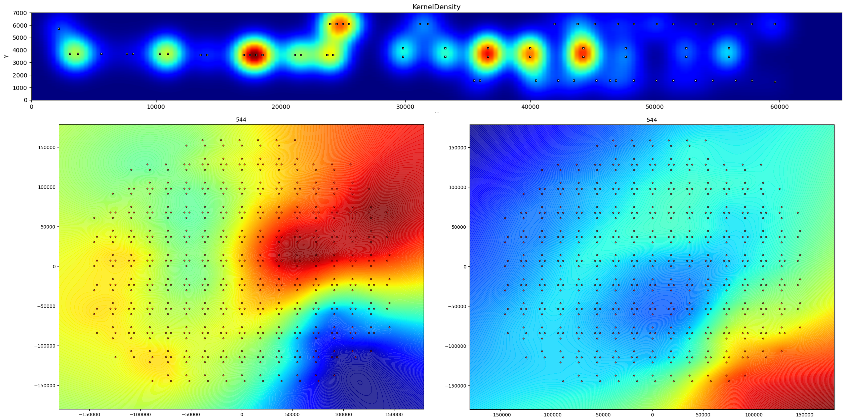
Figure 1: Construction of a congestion occurrence location prediction model in a factory (upper figure) and construction of a characteristic prediction model for semiconductor silicon wafers (lower figures)

この研究が世の中にもたらす可能性
Research Possibilities: what the research create to the World
製造業
製造工程のスマート化(品質予測、生産スケジューリング最適化,配置・移動経路最適化など)
Manufacturing
Smartization of manufacturing process (quality prediction, production scheduling optimization, layout and movement path optimization, etc.)
——————————-
Research 02
心動・血管の動きを数理モデル化し、生体情報のセンシングデータからヒトの状態を検知する
非接触センサを用いた高精度非接触バイタルセンシング
Mathematically modeling cardiac and vascular motion to detect human physiological conditions based on biological information sensing data
High-Precision Non-Contact Vital Sensing Using Non-Contact Sensors
“センシング×バイタル” と題して、ヒトの動作を数理的にモデリングすることで、直接触れ合うことなく人の状態が判別できる、非接触センシング技術に応用しようと取り組んでいます。その1つとして、ヒトの心拍・血圧といったバイタルの変化を、電波を用いて捉え、その情報に基づきストレス等の推定を行う技術の開発が挙げられます。この技術を応用して、さらに、独居老人見守りシステム(バイタル、転倒などの検知)の開発も手掛けています。私はセンシングにマイクロ波を送受信するドップラーセンサを用いています。従来の技術では、電波の照射範囲内の全ての動きを捉えてしまうため、外乱とノイズによる精度低下が著しいという問題を抱えていました。これに対して、私たちが提案する手法では動作自体をモデリングすることでノイズ除去が可能になっています。
Under the title of “Sensing × Vital,” we are working to apply mathematical modeling of human motion to non-contact sensing technologies capable of determining a person’s condition without physical contact. One example of this is the development of a technology that captures changes in vital signs such as heart rate and blood pressure using radio waves, and estimates conditions such as stress based on that information. Applying this technology, we are also developing a monitoring system for elderly people living alone (detecting vital signs, falls, etc.). We use a Doppler sensor that transmits and receives microwave signals for sensing. Conventional technology captures all motion within the radio wave irradiation range, resulting in significant accuracy degradation due to disturbances and noise. In contrast, our proposed method enables noise reduction by modeling the motion itself.
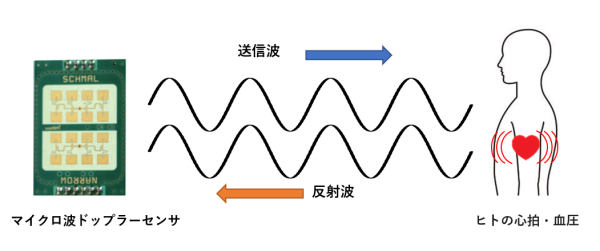
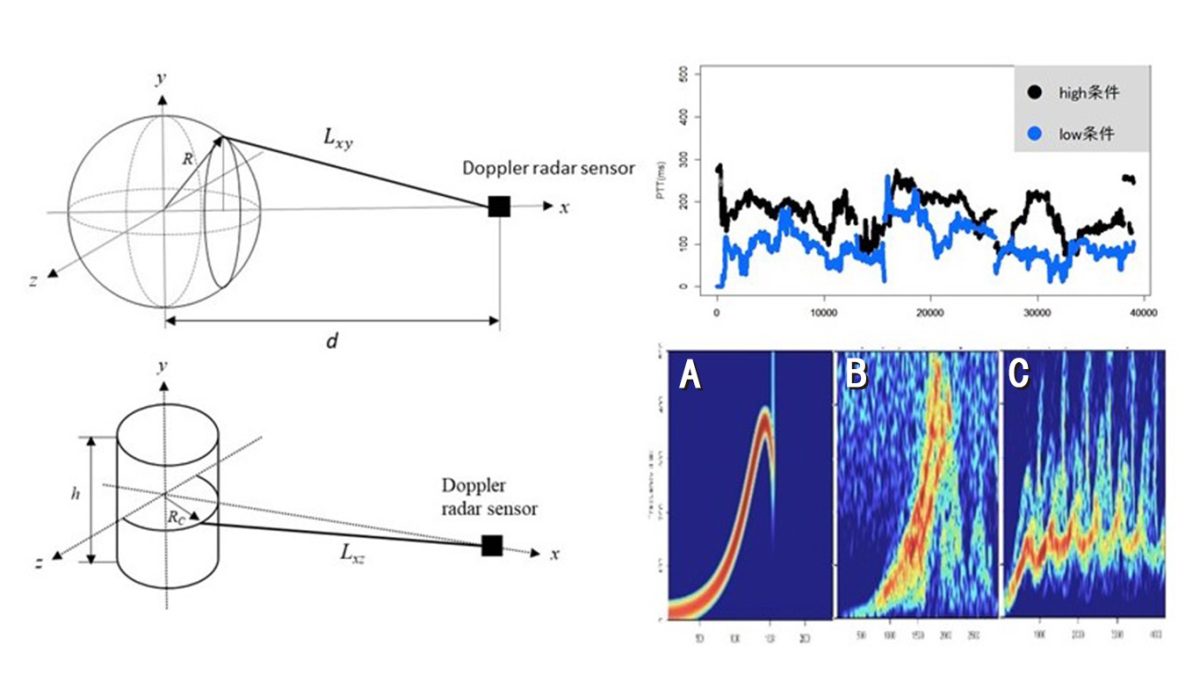
Figure2: Principle of a Doppler sensor (top). In our research, cardiac motion is modeled by assuming the heart as a sphere whose radius varies according to an arbitrary function. The mathematical models of the heart and a blood vessel (bottom left) and the results of continuous blood pressure estimation using non-contact sensing (bottom right, upper). Mathematical model of a fall (bottom right, lower, A) and waveform during an actual fall (bottom right, lower, B). These differ from the waveform observed during walking (bottom right, lower, C).
この研究が世の中にもたらす可能性
Research Possibilities: what the research create to the World
医療・介護
非接触センシングによるプライバシーに配慮した見守りシステムの開発
Medical and nursing care
Development of privacy-conscious monitoring systems using non-contact sensing technology
これまでの産学官連携事例
Collaborations
国際医療福祉大学
International University of Health and Welfare
2022/4 –
内視鏡検査補助システムの開発
Development of an Endoscopic Examination Assistance System
東京応化工業株式会社
Tokyo Ohka Kogyo Co., Ltd.
2020/10 –
半導体原材料の品質・需要予測
Quality and Demand Forecasting for Semiconductor Raw Materials
ソニーセミコンダクタマニュファクチャリング株式会社
Sony Semiconductor Manufacturing Corporation
2017/4 –
半導体生産技術のスマート化に関する研究
Research on Smartization of Semiconductor Production Technologies
ホンダリサーチインスティチュート株式会社
Honda Research Institute Japan Co., Ltd.
2018/4 – 2020/3
生理データからの快不快情動・覚醒状態予測モデルの開発
Development of a Model for Predicting Pleasant–Unpleasant Emotions and Arousal States from Physiological Data
実績
Achievements
2024/10
論文 |Journal
Takashi Ota & Kosuke Okusa, “Model-based estimation of heart movements using microwave Doppler radar sensor“. Journal of Physiological Anthropology, 43(1), 27 (2024)..
2024
特許 |Patent
出願⼈ ︓中央⼤学、発明者:大草 孝介、太田 隆「生体情報推定方法、生体情報推定プログラム、生体情報推定装置、及び生体情報推定システム」(特開2025-170999(2025年11月20日公開))
Biometric Information Estimation Method, Biometric Information Estimation Program, Biometric Information Estimation Device, and Biometric Information Estimation System
2019/7
受賞 |Award
SIIQ技術大賞, 半導体製造における撮像欠陥数の推定に関する統計的研究, 九州半導体・エレクトロニクスイノベーション協議会(SIIQ)
SIIQ Technology Grand Prize, Statistical Study on Estimating the Number of Imaging Defects in Semiconductor Manufacturing, SIIQ
2018/12
受賞 |Award
Best of the Best Paper Award, Prediction of the Number of Defects in Image Sensors by VM using Equipment QC Data, IEEE International Symposium on Semiconductor Manufacturing (ISSM)
2017/7
受賞 |Award
Best Paper Award, Statistical Indoor Location Estimation for the NLoS Environment Using Radial Extreme Value Weibull Distribution, The 2017 International Conference of Computational Statistics and Data Engineering
経歴
Career
2012/3
中央大学大学院理工学研究科経営システム工学専攻 修了(博士(工学))
Completed Industrial and Systems Engineering, Graduate School of Science and Engineering, Chuo University (Doctor (Engineering))
2012/4-2014/3
中央大学理工学部 助教
Assistant Professor, Faculty of Science and Engineering, Chuo University
2014/4-2020/3
九州大学大学院芸術工学研究院 助教
Assistant Professor, Graduate School of Design, Kyushu University
2014/4-2020/3
横浜市立大学データサイエンス学部 准教授
Associate Professor, School of Data Science, Yokohama City University
2020/10-2022/3
中央大学研究開発機構機構 客員准教授
Visiting Associate Professor, Research and Development Initiative, Chuo University
2020/4-現在
中央大学理工学部ビジネスデータサイエンス学科 准教授
九州大学応用生理人類学研究センター 協力研究員
横浜市立大学データサイエンス学部 客員准教授
Associate Professor, Department of Data Science for Business Innovation, Faculty of Science and Engineering, Chuo University
Collaborative Researcher , Physiological Anthropology Research Center, Kyushu University
Visiting Associate Professor, School of Data Science, Yokohama City University
Photographer: Hajime Kato Editor:Mayumi Nishioka

