







Research 01
あいまいな「健康」のその先にある、顧客一人一人の最終目標の実現を支援する
顧客の「健康目標」に寄り添う、支援型マーケティング
Supporting each customer’s ultimate goals that lie beyond the vague concept of ‘good health
Supportive marketing aligned with customers “health goals”
健康は多くの企業が重視する顧客のウェルビーイングの一側面です。しかし健康はあくまでも手段であって、顧客には、「いつまでも旅行を楽しみたい」「長く働きたい」といった、健康を通して実現したい最終目標があります。多様な健康目標が存在し、それが明確であるほど健康関連サービスの継続利用が促進されることが明らかになっています。目標の周りには、それを実現する商品やサービスがつらなる顧客独自の世界が広がっています。企業にとっては、その世界を把握し、目標実現に自社がどう貢献できるのかを明示することが課題です。その理論と実務への応用について研究しています。
Health is one aspect of customer well-being that many companies target. However, health is only a means to an end. Customers have ultimate goals they want to achieve through their health, such as “to enjoy lifelong traveling” or “to work as long as possible.” It has been shown that the more diverse and clearly defined health goals are, the more likely they are to promote the continued use of health-related services. Around these goals lies a customer’s unique world of products and services that assist them in realizing their goals. The challenge for companies is to understand this world and to clearly show how the company can contribute to the realization of these goals. I am conducting research on both the theoretical framework and practical applications.
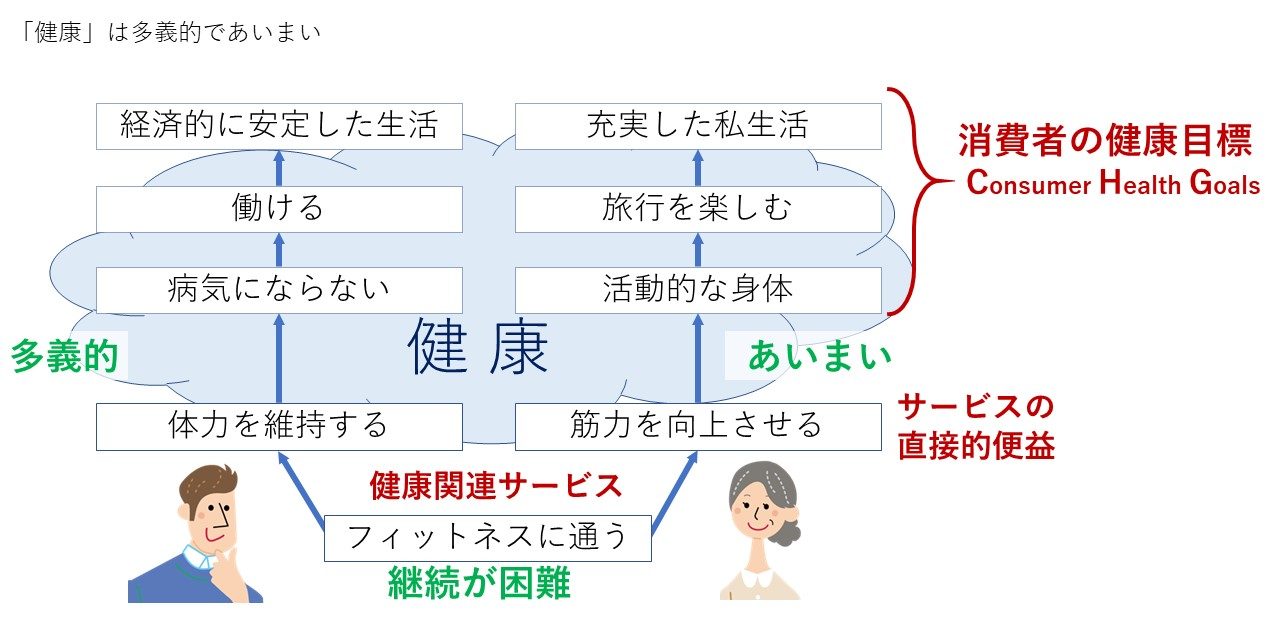
“健康のため”と一口に言っても、本人にとっても曖昧なままであったり、人や状況によってその意味やその先にある目標が異なったりします。そのため、「健康」のために利用するサービスに期待する便益も不明確になり、継続が困難になりやすいのです。
Figure 1: “Health” is a multifaceted concept that includes not only physical and mental health but also social and existential meanings.
The word “health” can be ambiguous, even to an individual, and its meaning and goals can differ depending on the person and situation.
Therefore, the benefits that customers expect from services for “health” become unclear, making it difficult for them to continue using these services.
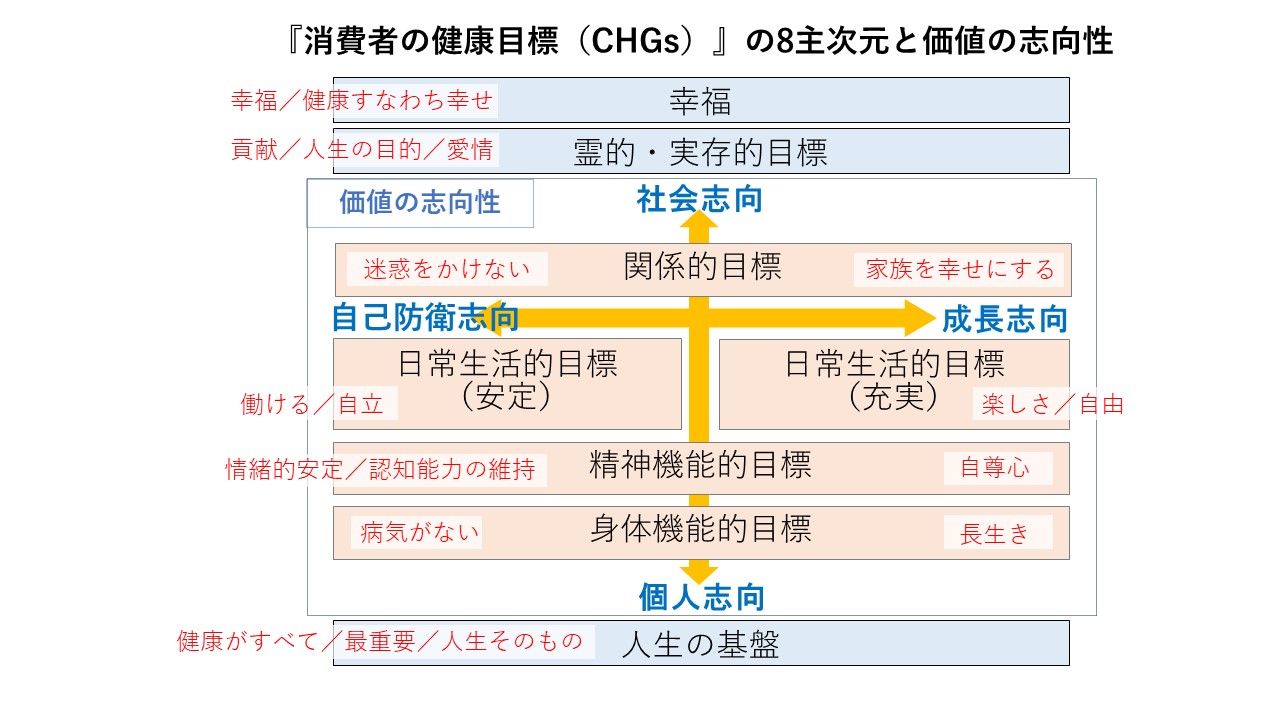
「健康によって消費者が実現したい最終目標」であるCHGsは、8 主次元・35 下位次元からなる多様な目標があり、うち6主次元は「個人─社会」「成長─自己防衛」という価値の志向性のもとに分類されることが分かりました。赤字は各次元の内容例です。
Figure 2: Consumer health goals (CHGs) are very diverse, ranging from concrete to abstract goals.
CHGs, which are “the ultimate goals that consumers want to achieve through health,” comprise 8 main dimensions and 35 sub-dimensions, of which 6 main dimensions are categorized under the value orientations of “individual-society” and “growth-self-protection.” Red text indicates examples of each dimension’s content.

この研究が世の中にもたらす可能性
Research Possibilities: what the research create to the World
「健康」を扱う業界
健康に関わる商品・サービス(以下、プロダクト)は、成果を感じ始めるまでに時間がかかるため、いかに継続してもらえるかが鍵となります。 顧客の健康目標に対し、自社の提供ベネフィットが果たす役割を理解することで 、継続利用を促進するプロダクト設計、適切な訴求や差別化、新プロダクトの創出、他社との効果的な協業などが可能になります。
“Health”-related industry/businesses
It takes time for results to show from health-related products and services, so the key lies in how to keep customers engaged. Understanding the role of your company’s benefits in meeting the health goals of your customers will enable you to design products that promote continuous use, as well as to make appropriate appeals and differentiation, create new products, and collaborate effectively with other companies.
Research 02
ウェルビーイングは、掲げるだけでは届かない。マーケティングの視点で、実効性を追求する。
マーケティングにおけるウェルビーイングの理解と実現
Well-being cannot be achieved merely by declaring it as a goal. Here, we pursue effectiveness from a marketing perspective.
Understanding and achieving well-being within marketing
ウェルビーイング(以下、WB)という言葉が、経営やマーケティング分野で用いられることが多くなりました。その一方で、WB概念の範囲は非常に広く、定義もさまざまで、汎用的な測定尺度もないのが現状です。WB向上を目指しつつも、どう取り組んでいけばよいか悩ましい企業も多いのではないでしょうか。理念として提示するだけではなく、マーケティングの実践としてWBを実現するための枠組みが求められています。こうした課題に応えるため、WBの理論的背景を整理し、事例を分析し、測定可能性を追求しながら、持続可能な実践モデルの確立を目指しています。
The term well-being (WB) is increasingly used in management and marketing fields. However, the scope of the WB concept is broad, and definitions vary widely; currently, there is no generic measurement scale. Many companies seeking to enhance well-being likely struggle with how to approach this goal effectively. A framework is needed to realize WB as a marketing practice rather than merely presenting it as a philosophical concept. To meet these challenges, we are working to establish a sustainable practice model by organizing the theoretical background of WB, analyzing case studies, and pursuing measurability.
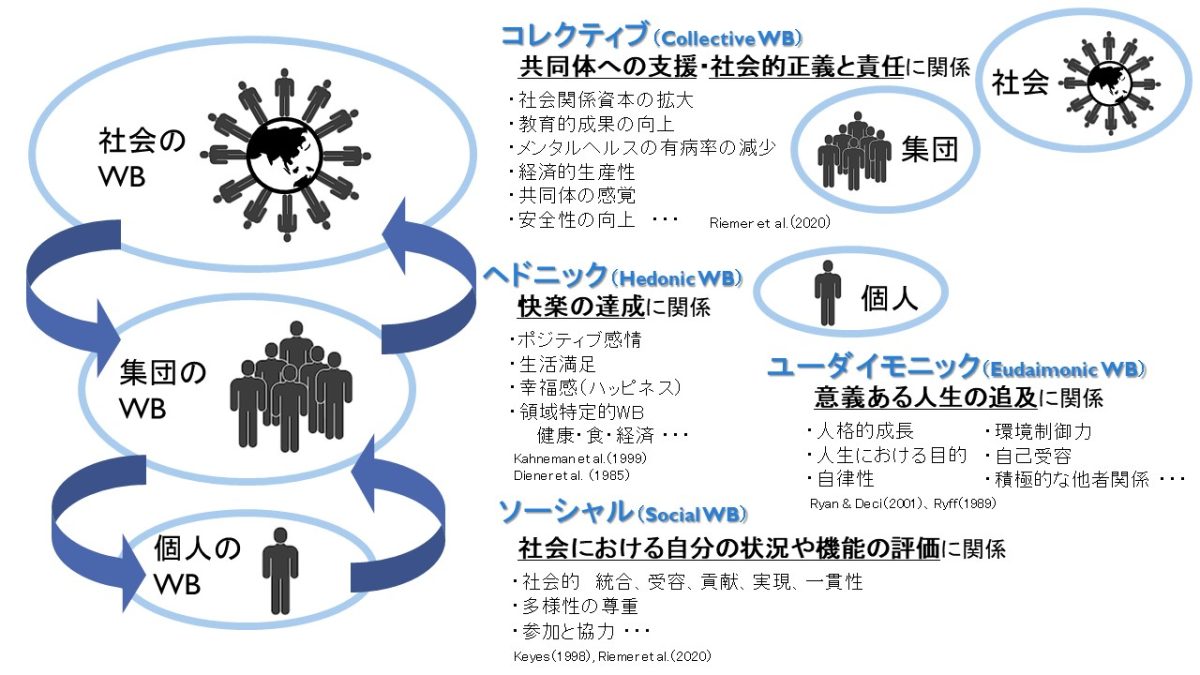
自社の目指すウェルビーイングが何かを理解するためには、前提となるウェルビーイング概念の整理が欠かせません。
Figure 3: Well-being involves a multi-layered background and interactions that illustrate the individual, groups, and society.
To understand what kind of well-being a company aims to achieve, it is essential to first clarify the underlying well-being concepts that serve as the foundation.
この研究が世の中にもたらす可能性
Research Possibilities: what the research create to the World
ウェルビーイング向上を掲げる業界
ウェルビーイングにはさまざまな次元があって幅広く、定義も多様なため、その言葉だけでは理念に終わってしまいかねません。自社が実現したいウェルビーイングの姿を理論的に明確化し、 測定可能な指標として特定することで、マーケティングの実践目標として、実現へとつなげていくことができます。
Industries advocating for well-being enhancement
Since well-being has many dimensions and a wide range of definitions, the term alone may remain merely an abstract ideal. By theoretically clarifying the vision of well-being that your company aims to achieve, and identifying it using measurable indicators, well-being can be realized as a practical marketing goal.
Research 03
顧客にとってのベネフィットを起点に、企業の成果をもたらす関係性を築く
継続利用に導く「顧客視点」のリレーションシップ構築とは
Starting with the benefits for the customer, building customer relationships that bring positive results to the company.
Customer-Perspective Relationship Building for Sustained Use
顧客の継続利用は、企業に利益をもたらします。ポイント制度や優待価格などが、そのための代表的な施策です。しかし、経済的、受動的な繋がりだけでは結局は長続きしません。例えば、信頼や愛着に基づく絆や、他の企業にスイッチしてしまうことを防ぐバリアが、企業と顧客の双方にとって望ましい関係性をもたらすことが明らかになっています。「リレーショナル・ベネフィット」(特別扱い、安心、対人的なつながりといった顧客にとってのメリット)や、「スイッチング・バリア」(新しい企業を探すのに手間がかかる、スタッフとの親しい関係が失われてしまう、といったスイッチをためらわせる障壁)、「献身に基づくロイヤルティ」(進んで使う)、「制約に基づくロイヤルティ」(仕方なく使う)、といった顧客心理をどのようにマネジメントすればよいのかを研究しています。
Sustained customer use brings benefits to a company. Point systems and preferential pricing are typical measures for this purpose. However, economic and passive connections alone are not sufficient for long-term relationships with customers. Furthermore, it has been shown that ties based on trust and attachment, as well as barriers that prevent customers from switching to other companies, can result in desirable relationships for both the company and its customers. Some examples are “relational benefits” (benefits to the customer such as special treatment, security, and interpersonal connections), “switching barriers” (barriers that make people hesitate to switch, such as the hassle of finding a new company or the loss of a close relationship with staff), as well as “dedication based loyalty (willing to use) ” and “constraint based loyalty” (reluctant to use). I am researching how to effectively manage these customer psychological factors.
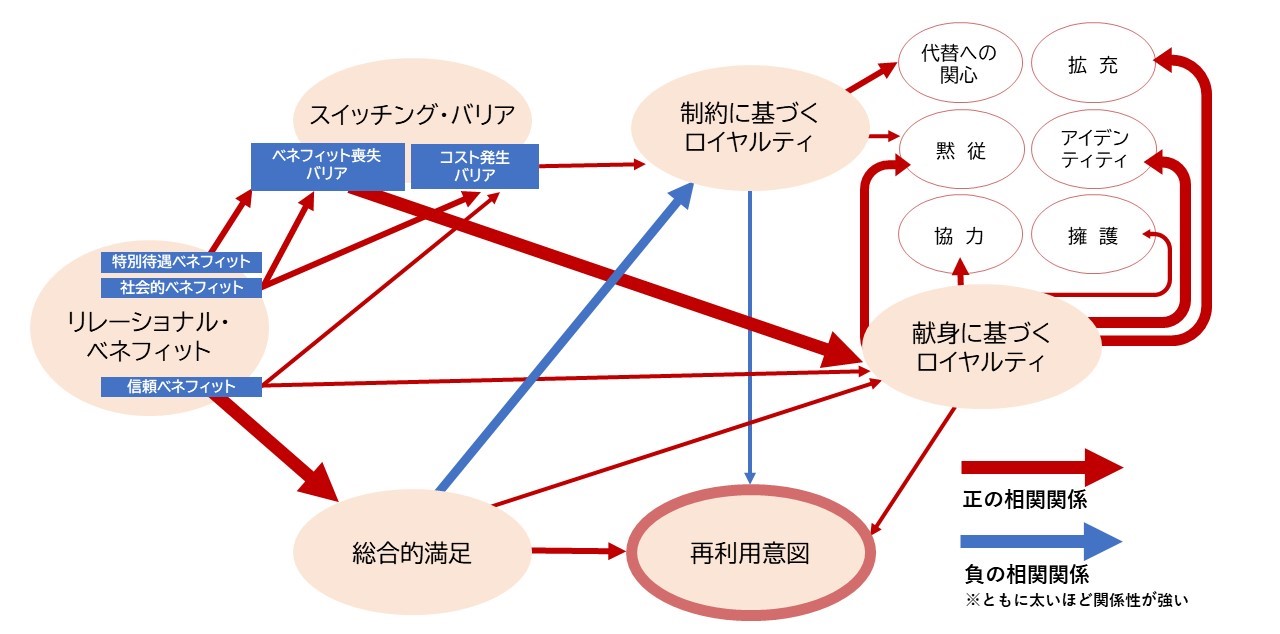
Figure 4: The three relational benefits of “social Benefits,” “special treatment benefits,” and “confidence benefits” form “Overall Satisfaction” and “dedication-based loyalty” (willingness to use company products and services), which ultimately increase “reuse Intention.” At the same time, relational benefits form two types of switching barriers, “benefit-loss barriers” and “cost-incurrence barriers.” These barriers have different effects on “dedication based loyalty” and “constraint based loyalty” (use by default choice), and they ultimately affect “reuse intention.”
この研究が世の中にもたらす可能性
Research Possibilities: what the research create to the World
顧客関係を重視する業界
「顧客満足」や「NPS(ネット・プロモーター・スコア)」 *)を顧客関係の成果指標とする企業も多いことでしょう。それらをもたらす愛着やしがらみといった、より繊細な顧客心理に着目することで、指標向上に貢献する具体的な顧客マネジメントを検討することが可能となります。それは同時に、自社と顧客との関係が顧客自身にもたらすベネフィットを明確にすることでもあり、顧客のウェルビーイング向上につながります。
*) NPS(ネット・プロモーター・スコア):顧客ロイヤルティを測る指標の一つ。友人や同僚にその企業を推奨する可能性を0~10の11段階で答えさせ、NPS = 推奨者の割合(%) – 批判者の割合(%)で算出される。
Customer relationship-oriented industries
Many companies use “customer satisfaction” and “NPS” (Net Promoter Score)*) as outcome indicators of customer relationships. By focusing on more sensitive customer psychology factors, such as the attachments and ties that foster these indicators, it is possible to consider specific customer management that contributes to the improvement of such outcome indicators. At the same time, this will also clarify the benefits that the relationship between the company and its customers brings to the customers themselves, leading to improved customer well-being.
*) NPS (Net Promoter Score): One of the indicators used to measure customer loyalty. It is calculated by having customers answer the likelihood of recommending the company to friends and colleagues on an 11-point scale from 0 to 10, where NPS = percentage of recommenders (%) – percentage of critics (%).
これまでの産学官連携事例
Collaborations
大手マーケティング・リサーチ会社、食品メーカー、アミューズメント企業
Major marketing research firm, food manufacturer, amusement company, and pharmaceutical company
2024 –
産学連携生活者研究プロジェクト「ケア」テーマ:セルフケアの消費者行動に関する調査研究支援
Industry-Academia collaborative consumer research project on consumer affairs with the theme, “Care”: Support for survey research on self-care-related consumer behavior
大手国内長距離交通会社
Major domestic long-distance transportation company
2015 – 2017
顧客満足度調査の改善に関する学術支援
Academic support for improving customer-satisfaction surveys
サービス産業生産性協議会
Service Productivity & Innovation for Growth (SPRING), Japan Productivity Center
2008 – 2018
JCSI(日本版顧客満足度指数)の開発、改善、学術支援
Development, improvement, and academic support for JCSI (Japanese Customer Satisfaction/Consumer Sentiment Index)
実績
Achievements
2025/10
書籍 |Book
『顧客視点のサービス・リレーションシップ-消費者心理に基づくサービス継続のマーケティング』 千倉書房
Customer-Oriented Service Relationships: Marketing of Service LoyaltyBased on Consumer Psychology, Chikura Shobo Co., Ltd.
2024/10
論文 |Journal
「健康関連サービスにおける『消費者の健康目標』の理解-質的データ分析による次元把握と継続利用への影響の検証」『消費者行動研究』, 31(1), 1-38.
“Understanding ‘Consumer Health Goals’ in Health-Related Services: Identification of Dimensions through Qualitative Data Analysis and Impacts on Continued Use,” Advances in Consumer Studies, 31(1), 1-38.
2024/9
論文 |Journal
「現代マーケティングの目指すべき『顧客支援』とは : サービス視点とリレーションシップ志向の重要性と課題」『商学論纂』, 66(1・2), 1-49.
“‘Support Customers’ as a modern marketing objective: Importance and challenges of service perspective and relationship orientation,” The Journal of Commerce, 66 (1&2), 1-49.
2013/5
表彰(論文)|Award (Journal)
日本商業学会 2013年 優秀論文賞 「サービス業におけるスイッチング・バリアの先行指標と成果指標」(『流通研究』, 14(2・3), 17-53)
Japan Society of Marketing and Distribution (JSMD), Best Paper Award 2013. “Antecedents and Outcomes of Switching Barriers in Service Industries,” International Journal of Marketing & Distribution, 14 (2 & 3),17-53.
2007/12
表彰(論文)|Award (Journal)
日本消費者行動研究学会 優秀論文賞 「顧客視点のサービス・リレーションシップ・モデル-リレーションシップ構築におけるスイッチング・バリアと顧客ロイヤルティの役割」
(『消費者行動研究』, 13(1), 29-56)
Japan Association for Consumer Studies (JACS), First Best Paper Award (FY 2007). “Customer-Oriented Service Relationship Model: The Roles of Switching Barriers and Customer Loyalty in Building Relationships,” Advances in Consumer Studies, 13(1), 29-56.
経歴
Career
1997/3
京都大学 教育学部 教育心理学科Cコース 卒業
Graduated from Kyoto University, Faculty of Education, Department of Educational Psychology, Course C
1997/4-1998/4
株式会社三洋キャリア開発 人材アセスメント研究所
Human Resources Assessment Research Institute, Sanyo Co., Ltd.
1998/9-2000/8
エス・ピー・エス・エス株式会社
SPSS Japan Inc.
2000/9-2003/1
株式会社ソフマップ CRM部
CRM Department, Sofmap Co., Ltd.
2003/2-2004/2
株式会社エクスパイラル(NTTデータ100%出資)
Exspiral Co., Ltd. (wholly owned by NTT DATA)
2005/3
法政大学 社会科学研究科 修士課程 経営学専攻 マーケティングコース 修了
Completed master’s program in Business Administration, Marketing Course, Graduate School of Sociology, Hosei University
2005/4-2017/3
多摩大学 経営情報学部 助教授、准教授
Associate Professor, School of Management and Information Sciences, Tama University
2009/3
法政大学大学院 経営学研究科 経営学専攻 博士課程 修了、博士(経営学)
Completed doctoral program in Business Administration, Graduate School of Business Administration, Hosei University, Doctor (Business Administration)
2017/4-現在
中央大学 商学部 准教授
Present Associate Professor, Faculty of Commerce, Chuo University
Photographer: Hajime Kato Editor: Kokoro Ogawa

